• Amazon Alert: The Era of “Universal” Review Sharing is Ending

    Amazon Alert: The Era of “Universal” Review Sharing is Ending

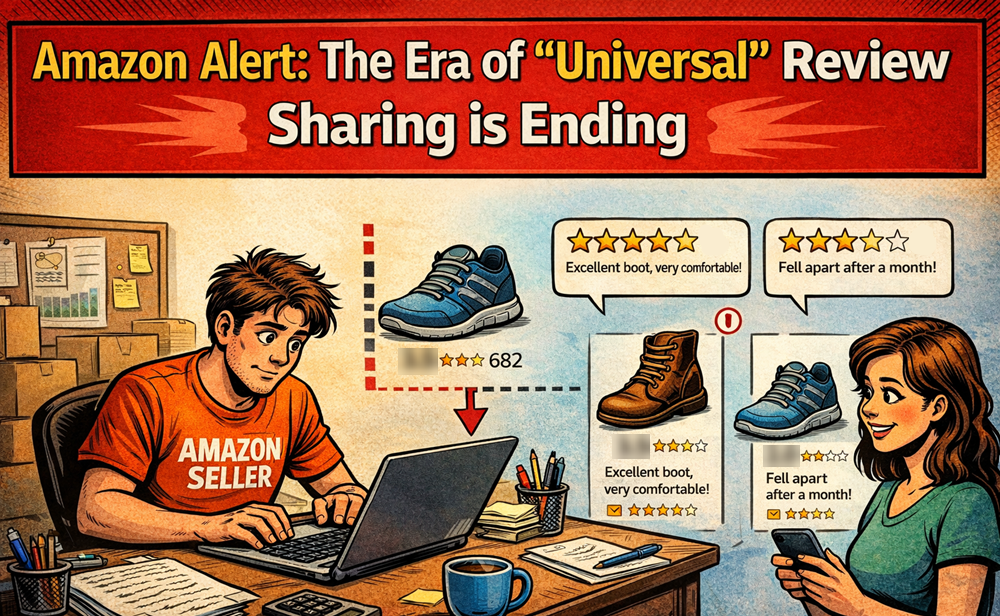
    Amazon is fundamentally changing how customer reviews are shared across variation families (parent-child ASIN structures). Starting February 12, 2026, a phased rollout began that restricts review sharing to only those products with “minor differences”.  According to Amazon reviews will only be shared when product variations have minor differences that don’t affect a product’s core functionality, otherwise reviews will no longer appear on variations with significant differences.

    In their own words, “Star ratings and rating counts help customers understand the overall feedback on a product. When products in a variation have significant differences in features or specifications, shared reviews may not accurately reflect the specific variation a customer is considering.”

    In other words, variations that are unique enough should have their own reviews. If your products are deemed to have “significant differences,” they will no longer share a pooled review count or star rating. This shift aims to provide customers with more accurate, product-specific feedback to inform their purchasing decisions.

    Read Amazon’s full announcement here:

    Guidelines for reviews shared across product variations

    What’s Changing?

    A few things.

    Eligibility-Based Sharing

    Reviews will now only be shared between variations with minor differences that do not affect the product’s functionality.

    Phased Category Rollout

    The update is being implemented gradually by product category from February 12, 2026, through May 31, 2026.

    30-Day Warning

    Amazon has committed to sending an email notification to sellers 30 days before their specific products are affected. We’ll see if that actually happens.

    Rating Impact

    For products no longer eligible for sharing, child ASINs may see a significant reduction in displayed review counts and a change in star ratings.

    What Will Still Share Reviews?

    Amazon has explicitly listed variation types that will continue to share reviews:

    • Color or pattern variations.
    • Size variations that maintain the same function (e.g., king vs. queen bedding).
    • Pack size or quantity variations.
    • Secondary scents for products where scent isn’t the primary focus (e.g., lemon-scented vs. unscented cleaners).
    • Model fitments for the same product type (e.g., different phone models for the same case style).

    Action Plan for Sellers

    We’re all used to the changing landscape that is Amazon.  It’s hard to be an Amazon seller and not be ready to make adjustments, sometimes at a moment’s notice.

    To prepare for this rollout, which is currently in progress (till May 31st, 2026), we recommend taking the following steps:

    1. Audit Your Inventory: Use the “Manage All Inventory” tool to review your current variation themes.
    2. Ensure Theme Accuracy: Confirm that your variation themes accurately reflect the differences between products (e.g., ensure a color variation is used for color differences, not a quantity variation).
    3. Remediate if Necessary: If you update your variation themes after the change takes effect, reviews will be re-shared—but only for products that meet the new eligibility criteria.

    The Bottom Line

    This is not a universal “split” of all reviews. However, for any variation family where the differences are functional rather than cosmetic, expect your review counts to decouple as Amazon moves toward ASIN-specific feedback.


    Contact us at eCom Triage


    Danan Coleman

    Founder

  • Amazon Lens Live: AI-Powered Shopping with Real-Time Scanning

    Amazon Lens Live: AI-Powered Shopping with Real-Time Scanning

    Amazon is once again raising the bar for online shopping with the launch of Lens Live, an AI-powered feature within the Amazon Shopping app. Combining real-time product scanning, visual search, and insights from Rufus, Amazon’s AI shopping assistant, Lens Live makes it faster and easier than ever for customers to discover, compare, and buy products.

    What Is Amazon Lens Live?

    Lens Live builds on the success of Amazon Lens, which already allowed users to search using photos or barcodes. Now, with Lens Live, the camera automatically scans items in real time and displays a swipeable carousel of product matches at the bottom of the screen.

    Shoppers can:

    • Focus on a specific product by tapping it in the camera view
    • Compare options instantly in the carousel
    • Add items to cart with a tap on the “+” icon
    • Save to wish lists by tapping the heart — all without leaving the camera

    This streamlined flow takes shoppers from inspiration to checkout in just a few taps.

    AI-Powered Insights with Rufus

    Lens Live integrates directly with Rufus, Amazon’s AI shopping assistant, to provide:

    • Quick product summaries highlighting key features
    • Suggested questions to ask while browsing
    • Fast, conversational answers about what makes a product stand out

      Instead of opening multiple tabs or scrolling through reviews, shoppers get relevant insights directly in the camera view, speeding up research and decision-making.

      How It Works Behind the Scenes

      Lens Live is powered by a sophisticated tech stack:

      • On-device computer vision models detect products in real time as customers pan their cameras.
      • Deep learning visual embedding models match the view against billions of Amazon products.
      • AWS services like Amazon OpenSearch and SageMaker enable large-scale machine learning deployment.

      This combination makes Lens Live both fast and accurate, with minimal effort required from the customer.

      Rollout and Availability

      Lens Live is now available to tens of millions of U.S. customers using the Amazon Shopping app on iOS. Amazon plans to roll it out to all U.S. customers in the coming months.

      Traditional Lens features — snapping a photo, uploading an image, or scanning a barcode — remain available for those who prefer them.

      Why Lens Live Matters for eCommerce

      Lens Live isn’t just another app feature. It’s a clear signal that the future of eCommerce is real-time, visual, and AI-driven.
      For retailers and brands, this means:

      • Discovery is becoming visual-first: customers expect to shop with their camera as easily as they do with a search bar.
      • AI is driving trust and efficiency: instant answers and insights reduce friction in the buying journey.
      • Speed matters: shoppers are more likely to convert when they can move from “see it” to “buy it” instantly.

      Brands that adapt early to these changes will be better positioned to meet rising customer expectations.

      Conclusion

      Amazon Lens Live represents a new frontier in digital retail: shopping that is instant, intelligent, and interactive. By combining visual search, real-time product matching, and AI-powered insights, Amazon is redefining what customers expect from online shopping.

      For eCommerce leaders, the lesson is clear: the future of retail will be visual, conversational, and AI-powered — and the time to adapt is now.

      Source:

      https://www.aboutamazon.com/news/retail/search-image-amazon-lens-live-shopping-rufus

    1. Amazon Steps Up Fight Against Fake Reviews After UK Watchdog Investigation

      Amazon Steps Up Fight Against Fake Reviews After UK Watchdog Investigation

      Amazon has pledged to intensify its efforts to combat fake reviews on its platform following a four-year investigation by the UK’s Competition and Markets Authority (CMA). The tech giant will implement measures including sanctioning British businesses that use fraudulent posts to enhance their ratings and banning users who repeatedly submit fake reviews. The agreement also addresses ‘catalog abuse,’ where sellers misuse reviews from unrelated top-performing products to deceive customers. These commitments aim to strengthen Amazon’s detection and removal processes for inauthentic reviews.

      What This Means for E-Commerce Sellers

      I have mixed feelings on this. 

      On the one hand, review manipulation SHOULD be quelled and those guilty of it should be reprimanded. Not all sellers do it to manipulate the system, some feel that they HAVE to do it in order to even be able to make a sale. Does that make it right? No.

      On the other hand, I believe that the hammer will only drop harder on those deemed guilty of review manipulation. Just because Amazon says you’re guilty doesn’t mean you are… For e-commerce businesses it is of even greater importance you maintain authentic customer reviews. I know of several companies out there that can get your reviews, it’s playing with fire in my opinion.

      Sellers should review their current practices to ensure compliance with the new guidelines. This includes refraining from incentivizing reviews, ensuring that product listings accurately represent the items being sold, and monitoring for any unauthorized or suspicious review activity

      Steps to Ensure Compliance

      1. Audit Your Reviews: Regularly monitor your product reviews for any signs of inauthenticity or manipulation.
      2. Avoid Incentivizing Reviews: Do not offer discounts, free products, or other incentives in exchange for positive reviews.
      3. Educate Your Team: Ensure that all members of your team understand the importance of authentic reviews and the potential consequences of non-compliance.
      4. Report Suspicious Activity: If you notice any suspicious review activity on your products, report it to Amazon promptly.

      By adhering to these practices, e-commerce sellers can maintain the integrity of their product listings and build trust with consumers.

      Conclusion

      Amazon’s commitment to combating fake reviews marks a significant step toward ensuring a fair and transparent e-commerce environment. For sellers, this is a timely reminder to prioritize authenticity and compliance in all aspects of their operations. Staying informed about regulatory changes and proactively addressing potential issues will be key to long-term success in the evolving digital marketplace.

      Sources:
      theguardian.com+7usnews.com+7uk.news.yahoo.com+7
      techxplore.com+20gov.uk+20reuters.com+20

    2. Intuit and Amazon Partner Up

      Intuit and Amazon Partner Up

      Great news this week in the world of e-commerce.  Another partnership has been announced, and this one will create waves (good waves) across the industry.

      The kind of waves that will add positive energy to the system.

      What Happened

      Intuit and Amazon have announced a multi-year strategic partnership to help Amazon sellers better manage their finances, access capital, and grow their businesses.

      Let’s be honest though, the main thing that matters (at least to me) is that Amazon will directly integrate with Quickbooks. 

      This collaboration (coming mid-2025)  focuses on providing sellers with tools and insights to improve profitability, cash flow, and tax compliance—all essential for scaling in the competitive e-commerce space.

      What It Means for Sellers

      First and foremost this will be a boon for those who sell on Amazon.

      The new partnership means:

      • Integration with Amazon Seller Central
        QuickBooks will be integrated directly into Amazon Seller Central as the preferred financial management solution, giving sellers easy access to tools that streamline their operations.
      • AI-Driven Insights
        Amazon sellers will gain access to financial insights like profitability tracking, cash flow analysis, and tax liability estimates, powered by Intuit’s advanced AI platform.

      Why It Matters for All E-Commerce Businesses

      This partnership highlights the growing importance of integrated financial tools for e-commerce sellers. By adopting platforms like QuickBooks, sellers can save time, make informed financial decisions, and confidently grow their businesses.

      Among the key benefits will be comprehensive financial management, and simplified access to capital.

      How Does It Affect Existing Finance Service Businesses?

      ConnectBooks | Shopkeeper | Finaloop

      They all have something to offer in this space. I’m only personally familiar with ConnectBooks. I think that there will always be a place for them but that they are going to need to pivot.

      Closing Thoughts

      It doesn’t matter if you do anything at scale. Shipping, finance, product sales, metrics, Amazon wants it ALL. Eventually they’re going to offer every solution those of us pioneered, but they will NEVER be able to do it as well as we can.

      References:

    3. How Tariff Terminator Revolutionizes Import Duties for Amazon Sellers

      How Tariff Terminator Revolutionizes Import Duties for Amazon Sellers

      Byline: Danan Coleman

      Even though Amazon claims they’re not raising fees in 2025, every dollar counts. From sourcing high-quality products to managing logistics and keeping up with advertising, your margins can feel razor-thin. I know they do for me.

      One overlooked area where you can reclaim significant costs?

      Import duties.

      When it comes to recouping these costs it helps to have a qualified expert in your corner.

      Who is Tariff Terminator?

      For those of us who don’t have a ton of experience in the import/export business, Tariff Terminator is a game-changing service created by Afolabi Oyerokun, a renowned expert in global sourcing and logistics. This tool is designed specifically to help e-commerce sellers — especially Amazon entrepreneurs — eliminate the need to navigate the labyrinth of customs classifications in order to ensure the best duty rate.

      Tariff Terminator finds better classifications 60-80% of the time which could possibly slash your import costs.

      Every dollar saved is a dollar of pure golden delicious profit for your business.

      Why Tariff Codes Matter to Amazon Sellers

      When you’re importing products into the United States, the tariff classification you choose dictates the duty rate you’ll pay. These classifications, known as Harmonized Tariff Schedule (HTS) codes, may seem like an afterthought, but they wield enormous influence over your bottom line. 

      The wrong HTS code can cost you thousands. If your product is misclassified, you could be paying a much higher duty rate than necessary — or worse, you risk fines or shipment delays. Correctly classifying your products can ensure compliance with customs and unlock significant savings.

      What is Tariff Engineering?

      Tariff engineering is the process of legally optimizing a product’s characteristics or classification to minimize import duties. It’s a highly specialized practice that can save Amazon sellers thousands, even tens of thousands of dollars annually.

      For example, a product classified under a 29.9% duty rate could, with expert guidance, be reclassified at a much lower rate — sometimes as low as 2.1%. 

      Afolabi’s Tariff Terminator has helped sellers save millions in unnecessary import costs by leveraging this strategy. For instance, one client reported saving $13,900 on a single shipment after adjusting their tariff code.

      Those are savings that can be reinvested into inventory, marketing, or other growth-driving activities.

      How Tariff Terminator Works

      Tariff Terminator is more than just a lookup tool. It’s a full-service solution for Amazon sellers.

      Here’s how it works: 

      1. Tariff Audit: Start with a $99.00 audit where Tariff Terminator evaluates your existing classifications to identify potential savings.
      2. HTS Code Optimization: Their team of experts reviews your products and recommends optimized HTS codes for reduced duty rates.
      3. Risk Mitigation: The service ensures your classifications are fully compliant, reducing the risk of penalties, fines, or cargo delays. 
      4. Code Monitoring: If there is a better code, you get code monitoring for free for 12 months. This means that if the government redefines anything that affects your import, you will know. Also, 

      It’s ridiculously affordable. You pay a one-time investment of a mere $499 if they uncover savings for you.

      No savings, no further charges. If you’re already using the best codes, you STILL get the code monitoring for 12 months!

      Why eCom Sellers Love Tariff Terminator

      Afolabi has built more than just a cost-saving tool — he’s built a lifeline for sellers navigating the complexities of global trade.

      With his decades of experience in supply chain and logistics, he understands the unique pain points of Amazon sellers and designed Tariff Terminator to solve them. 

      Ready to Start Saving? 

      Don’t let incorrect tariff classifications eat into your profits. Tariff Terminator is the trusted partner Amazon sellers need to optimize import duties and ensure compliance.

      Whether you’re a seasoned seller or just getting started, this tool can provide clarity and savings where you least expect it.
      👉 Try Tariff Terminator today and unlock your savings

      [one more thing]

      Where possible, it is highly recommended that you get a ruling letter from the Customs and Border Patrol. This is also possible through Tariff Terminator as part of their tariff engineering service.

      I am a big fan of learning what I need to know about something so that I can properly manage or address it, but not having to do it all myself. I learned that with my trademark… With that in mind, you can also get the data for requesting a ruling letter here. 

      https://www.cbp.gov/trade/rulings/ruling-letters

      A ruling letter from the U.S. Customs and Border Protection (CBP) is an official written decision issued by CBP in response to a request from an importer, exporter, or other interested party. It provides binding guidance on how CBP will apply customs laws and regulations to a specific set of facts or circumstances, such as:

      1. Classification: Determining the appropriate Harmonized Tariff Schedule (HTS) code for goods, which affects the duty rate.
      2. Valuation: Clarifying the proper method for determining the customs value of imported goods.
      3. Country of Origin: Establishing the country of origin for goods, which can impact tariffs or eligibility for preferential trade agreements.
      4. Marking Requirements: Explaining the proper marking requirements for imported goods.
      5. Other Customs Issues: Addressing specific compliance questions related to CBP regulations.

      Ruling letters are an essential tool for businesses involved in international trade. They help ensure compliance with U.S. customs laws, avoid unexpected costs, and resolve potential disputes proactively. It’s a binding decision, meaning CBP has to follow it as long as the facts stay the same.

      Basically, if the CBP certifies you’re using the right HTS Codes, then you are.


      Want more?

      Watch the full podcast about Tariff Terminator with Afolabi and Danan here: