

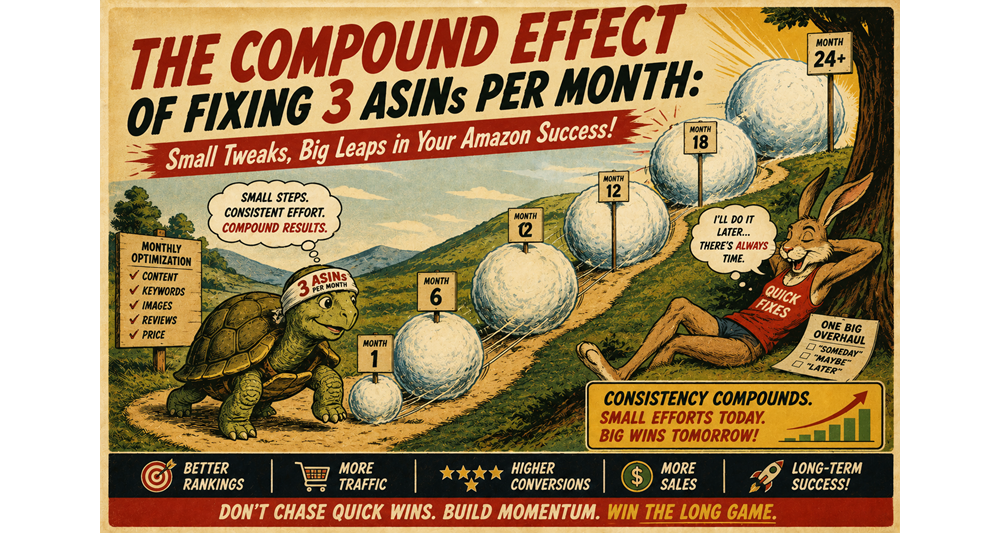
Alright, let’s talk about growth on Amazon. It’s not always about those massive, overnight successes you see in the headlines. Often, real, sustainable growth comes from consistent, incremental improvements. Think of it like compound interest – small actions, repeated over time, can lead to surprisingly significant results.
Today, we’re going to explore the “compound effect” of fixing just three ASINs per month.
Sounds manageable, right?
Let’s see how those little tweaks can snowball into big wins for your Amazon business.
The “One Big Fix” Myth: Why Gradual Wins the Race
Many sellers fall into the trap of thinking they need one massive overhaul to see significant growth. They dream of that one magic bullet, that single strategy that will suddenly skyrocket their sales. While big changes can sometimes be necessary, relying solely on them can lead to procrastination and overwhelm.
The beauty of focusing on a few ASINs each month is that it’s achievable, less daunting, and allows for focused attention on making meaningful improvements.
The Math of Small Improvements: Prepare for Some Simple (and Encouraging) Arithmetic
Let’s imagine you have, say, 20 ASINs in your catalog. If you commit to fixing just three of them each month, what happens over time?
- Month 1: 3 ASINs receive targeted improvements.
- Month 2: Another 3 ASINs get the TLC they deserve (now 6 total improved).
- Month 3: Yet another 3 ASINs are optimized (now 9 total).
- Month 6: You’ve systematically touched and hopefully improved 18 out of your 20 ASINs.
- Month 7 (and beyond): You’re now cycling back to your initially improved ASINs, armed with new data and insights to further refine them. This isn’t a one-and-done deal; it’s a continuous cycle of improvement.
Now, what exactly does “fixing” an ASIN entail? It’s not about slapping on a few extra keywords and calling it a day. It’s about making meaningful improvements that address key areas affecting performance. This could involve:
- Optimizing the title and bullet points: Focusing on high-converting keywords, improving readability, and clearly highlighting key benefits. Even a small increase in click-through rate (CTR) can lead to more traffic and sales.
- Enhancing the product description: Crafting compelling and informative descriptions that answer customer questions and paint a vivid picture of the product’s value. Better descriptions can boost conversion rates.
- Improving product images: Ensuring high-quality, visually appealing images that showcase the product from multiple angles and highlight key features. Good visuals are crucial for online sales.
- Updating backend keywords: Regularly researching and implementing relevant backend keywords that might be missed in the front-end content, expanding your reach in search results.
- Analyzing and responding to customer feedback: Identifying recurring issues or questions in reviews and Q&A, and then updating the listing to address them proactively. This can reduce negative feedback and improve customer satisfaction.
- A/B testing pricing or promotional strategies: Experimenting with small changes to pricing or running targeted promotions on specific ASINs to see what resonates with your audience.
- Reviewing category and browse node placement: Ensuring your product is in the most relevant categories to maximize visibility.
The Snowball Effect: How Small Fixes Lead to Big Wins
The magic of fixing three ASINs per month isn’t just about the number of listings you improve; it’s about the compounding effect of those improvements. Here’s how it works:
- Increased Visibility: Better keywords and optimized content lead to higher rankings in search results, meaning more potential customers see your product.
- Higher Click-Through Rates (CTR): Compelling titles and engaging visuals entice more shoppers to click on your listing.
- Improved Conversion Rates: Detailed descriptions, high-quality images, and addressed customer concerns lead to more purchases once shoppers land on your page.
- More Positive Reviews: By addressing customer feedback and providing clearer information, you can reduce negative reviews and increase positive ones, further boosting social proof and conversion rates.
- Increased Sales Velocity: The combination of higher visibility and better conversion rates leads to more sales, which in turn can improve your organic ranking and create a positive feedback loop.
- Reduced Advertising Costs: As your organic ranking improves, you may be able to reduce your reliance on paid advertising, leading to higher profit margins.
- Stronger Overall Account Health: Consistent attention to your listings contributes to a healthier Amazon account, making you less susceptible to suspensions and other issues.
The “Don’t Be a Perfectionist” Caveat: Progress Over Perfection
It’s important to note that “fixing” an ASIN doesn’t mean achieving absolute perfection. The goal is to make meaningful improvements based on data and best practices. Don’t get bogged down trying to make every single listing flawless in one go. Focus on making progress on those three ASINs each month, and the cumulative effect will be far more impactful than striving for unattainable perfection across your entire catalog simultaneously.
Dad Joke Break: Why did the Amazon seller only fix three ASINs a month? Because they wanted to take things one listing at a time!
Compounding Success
Stop chasing the elusive “magic bullet” and embrace the power of consistent improvement! Commit to fixing just three ASINs each month and witness the compound effect transform your Amazon success.
To learn more about prioritizing which ASINs to optimize first and data-driven strategies for listing improvement, click here.