• Step-by-Step: Submitting a Review Violation Case

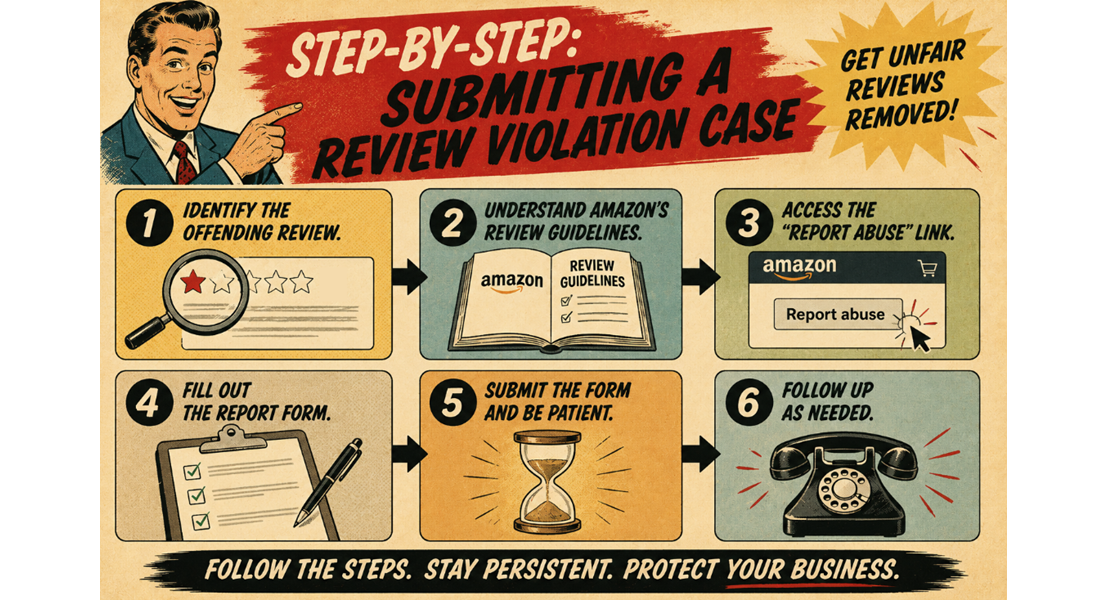
    Step-by-Step: Submitting a Review Violation Case

    Alright, folks, let’s talk about those pesky reviews that make your blood boil. You know the ones – they’re clearly fake, violate Amazon’s guidelines, or maybe the buyer just had a bad Tuesday and decided to take it out on your stellar widget. Ignoring them is like ignoring a leaky faucet; it might seem small at first, but eventually, it’ll flood your sales.

    So, let’s roll up our sleeves and learn how to fight back with a step-by-step guide to submitting a review violation case.

    Why Bother? (The “Why Your Mama Would Be Proud” Part)

    Before we get into the nitty-gritty, let’s quickly touch on why this is important. Those unfair reviews can tank your conversion rates, damage your brand reputation, and generally make your Amazon life more stressful than it needs to be.

    Getting rid of illegitimate feedback is crucial for maintaining a healthy listing and a thriving business. Think of it as weeding your garden – you gotta pull out the bad stuff so the good stuff can grow.

    The Step-by-Step Guide: Your Review-Busting Toolkit

    Here’s your battle plan for tackling those rogue reviews:

    Step 1: Identify the Offending Review

    First things first, you need to pinpoint the exact review that’s causing you grief. Head over to your product listing and find the review in question. Note down the date of the review and the reviewer’s name (or pseudonym).

    Step 2: Understand Amazon’s Review Guidelines (Know Your Enemy)

    Before you start firing off reports, make sure you know what constitutes a violation. Amazon’s Community Guidelines outline what’s not allowed in reviews. This includes:

    • Promotional content: Reviews that are clearly advertisements for other products or services.
    • Off-topic content: Reviews that have nothing to do with the product itself (e.g., political rants, shipping complaints – though shipping issues should be directed at the seller feedback).
    • Personal information: Reviews that reveal private details about the seller or other customers.
    • Obscene or offensive language: Self-explanatory, hopefully.
    • Bias: Reviews from family members, competitors, or those who have been paid to leave a review (this is a big no-no).
    • Misleading information: Factually incorrect statements about the product.

    Step 3: Access the “Report Abuse” Link (Your Secret Weapon)

    This is where the magic happens (or at least, where you start the process).

    1. Go to the specific product listing where the review is located.
    2. Scroll down to the “Customer reviews” section.
    3. Look for the individual review you want to report. Underneath the review text, you should see a “Report abuse” link. Click on it.
      • Pro Tip: Sometimes, this link isn’t immediately visible. Hovering your mouse over the review might make it appear.

    Step 4: Fill Out the Report Form (Be Clear and Concise)

    Clicking “Report abuse” will usually open a pop-up window or redirect you to a reporting form. Here’s how to fill it out effectively:

    1. Reason for reporting: You’ll likely be presented with a dropdown menu of reasons. Choose the option that best fits the violation you identified in Step 2. Be specific! Don’t just say “it’s a bad review.” Choose something like “The review contains promotional content” or “The review is off-topic.”
    2. Provide details (The “Evidence Locker”): This is crucial. In the text box provided, clearly and concisely explain why you believe the review violates Amazon’s guidelines. Reference the specific points from Step 2. For example:
      • “This review mentions a competing product by name and urges customers to buy that instead.” (Promotional content)
      • “The reviewer is complaining about the shipping speed, which is a fulfillment issue and not related to the product quality.” (Off-topic content)
      • “The reviewer states they received a free product in exchange for this review, which violates Amazon’s policy.” (Bias)
    3. Provide the date and reviewer name (Reinforce the Target): Include the date of the review and the reviewer’s name (or pseudonym) again in your explanation to ensure Amazon knows exactly which review you’re talking about.
    4. Attach evidence (If Applicable): If you have any supporting evidence (e.g., screenshots of messages, social media posts), some reporting systems might allow you to attach them. If not, clearly mention the evidence you possess in your detailed explanation.

    Step 5: Submit and Be Patient (The Waiting Game)

    Once you’ve filled out the form and attached any evidence, hit that “Submit” button. Now comes the hard part: waiting. Amazon’s review moderation team receives a high volume of reports, so it can take some time for them to review your case.

    Step 6: Follow Up (Gentle Nudging)

    If you haven’t heard back from Amazon after a reasonable amount of time (usually a few days to a week), you can try following up through Seller Central. Navigate to your “Customer Feedback” section and see if there’s any update on your reported review. You can also try contacting Seller Support, but be prepared to provide all the details of your initial report.

    Important Considerations (The “Don’t Be That Guy/Gal” Part)

    • Don’t report reviews simply because they are negative. The review must genuinely violate Amazon’s guidelines.
    • Be professional and factual in your reports. Emotional language won’t help your case.
    • Focus on the violation, not the reviewer.
    • Understand that Amazon’s decision is final. Not all reported reviews will be removed.

    Dad Joke Break: Why did the review get a bad grade? Because it didn’t make any cents!

    Take Control

    Tired of unfair reviews dragging down your listing? Take control! Follow this step-by-step guide to report review violations and protect your hard work.

    For more in-depth strategies on managing your Amazon reputation and dealing with negative feedback, book a call and find out how we can help.

    Ecom Triage removes negative Amazon reviews for you.
    Find out how.

  • The 5 Most Common Types of Removable Reviews

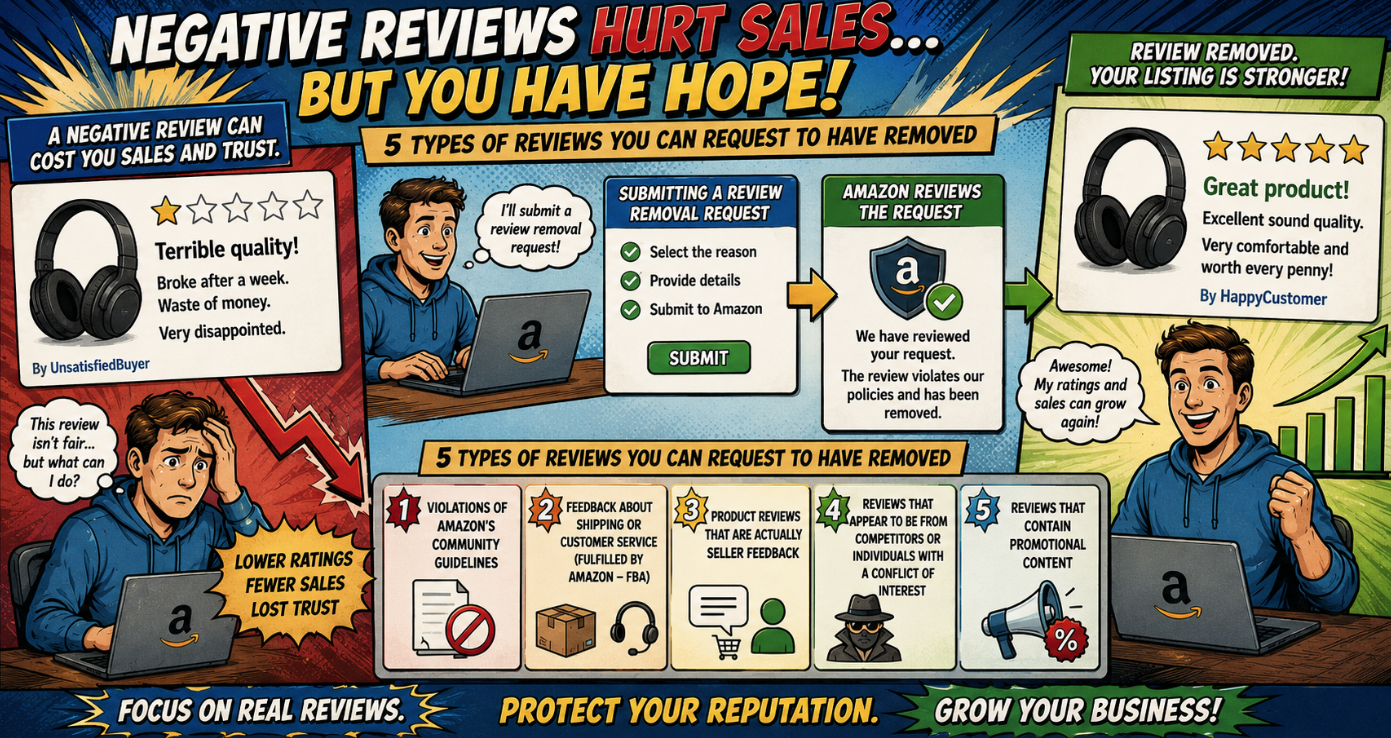
    The 5 Most Common Types of Removable Reviews

    Let’s face it, negative reviews can feel like a punch to the gut for any Amazon seller. You pour your heart and soul into your products, then BAM! A one-star review pops up, seemingly out of nowhere. But here’s a little secret: not all negative reviews are created equal, and more importantly, not all of them have to stick around like that stubborn uncle at Thanksgiving dinner. Understanding the different types of removable reviews is your first line of defense in protecting your hard-earned reputation and conversion rates. So, grab a cup of coffee (or your preferred beverage – no judgment here!), and let’s dive into the five most common types of reviews that might just qualify for removal.

    #1 Violations of Amazon’s Community Guidelines

    Think of Amazon’s Community Guidelines as the rulebook for leaving reviews. Just like in any good game, there are rules, and when someone breaks them, there are consequences. Reviews that contain obscene or offensive language, promote illegal acts, or include personal information (like phone numbers or addresses) are prime candidates for removal. It’s like showing up to a chess match with a water pistol – not allowed!

    #2 Feedback About Shipping or Customer Service (Fulfilled by Amazon – FBA)

    This is where things get interesting. If a negative review is solely focused on issues related to shipping or the customer service provided by Amazon under their FBA program, you might be in luck. Amazon takes responsibility for these aspects. It’s like blaming the restaurant for a slow delivery when the delivery guy works for a separate service. If the feedback clearly points the finger at Amazon’s fulfillment process and not the product itself, you have a solid case for removal.

    #3 Product Reviews That Are Actually Seller Feedback

    Sometimes, buyers get a little confused and leave feedback about their buying experience (like slow shipping from a third-party seller or poor communication) in the product review section. These are two distinct categories on Amazon for a reason! Product reviews should be about the product itself, its features, and its quality. If a review talks about the seller’s actions rather than the product, it’s misplaced and potentially removable. It’s like reviewing the movie based on the uncomfortable cinema seats – relevant to the experience, but not the main feature.

    #4 Reviews That Appear to Be From Competitors or Individuals With a Conflict of Interest

    This one requires a bit more detective work. If you suspect a review is coming from a competitor trying to sabotage your listing or someone with a clear conflict of interest (maybe a disgruntled ex-employee?), Amazon has policies against this. However, you’ll need to provide compelling evidence. It’s like catching someone trying to swap your prize-winning pumpkin with a rotten one at the county fair – you need proof! Keep an eye out for unusual patterns, similar negative reviews appearing on multiple competitor listings around the same time, or any other red flags.

    #5 Reviews That Contain Promotional Content

    Amazon wants genuine, unbiased opinions. Reviews that include promotional content, such as links to other websites or advertisements for other products, violate their guidelines. It’s like someone sneaking an ad into the middle of a heartfelt testimonial. These types of reviews undermine the integrity of the feedback system and are usually eligible for removal.

    What to Do When You Spot a Removable Review

    • Don’t Panic: Take a deep breath. It happens to the best of us.
    • Carefully Read the Review: Identify the specific reason for the negative feedback. Does it fall into any of the categories above?
    • Report the Review to Amazon: Go to the “Report a Product Review” tool in your Seller Central account. Provide clear and concise reasons why the review violates Amazon’s policies, referencing the specific guideline if possible. Be polite and professional in your communication.
    • Be Patient: Amazon’s review process can take some time. Follow up if you haven’t heard back within a reasonable timeframe.
    • Document Everything: Keep records of the reviews you’ve reported and any communication with Amazon.

    Removing unfair or policy-violating reviews can significantly improve your listing’s performance and maintain customer trust. It’s an ongoing process, but understanding these common types of removable reviews is a crucial step in protecting your Amazon business.

    Contact us for a demo.

  • How to Use Review Removal as a Launch Strategy

    How to Use Review Removal as a Launch Strategy

    Launching a new product on Amazon is an exhilarating yet challenging endeavor. You’ve poured time and resources into development, sourcing, and listing optimization. But even with a stellar product and a compelling listing, the initial hurdle of gaining traction and building social proof can feel insurmountable.

    Here’s a potentially unconventional yet powerful strategy: leveraging legitimate review removal to create a positive initial perception and accelerate your launch.

    The Chicken and Egg Problem of New Product Launches

    Every new Amazon product faces the same fundamental challenge: no reviews. In a marketplace driven by social proof, a listing with zero reviews often gets overlooked. Potential customers are hesitant to be the first to take a chance, and without that initial momentum, your product can languish in the search results, no matter how great it is.

    Traditionally, sellers focus on generating reviews through various (and often slow) methods like early reviewer programs, Vine, or post-purchase review requests. While these are important long-term strategies, they don’t address the immediate need for positive social proof during the crucial launch phase.

    The Power of a Clean Slate: Removing Illegitimate Negative Reviews Early

    This is where a strategic approach to review removal comes in. Instead of solely focusing on getting positive reviews, consider proactively identifying and removing any illegitimate negative reviews that might appear early on. Why? Because even one unfair or policy-violating negative review on a brand new listing can be disproportionately damaging.

    With no positive reviews to balance it out, it can kill your momentum before it even begins.

    What Constitutes an “Illegitimate” Negative Review?

    It’s crucial to understand that we’re not talking about manipulating or faking reviews. We’re focusing on identifying and removing reviews that violate Amazon’s own policies. These include reviews that:

    • Do not pertain to the product: Reviews about shipping issues (when you use FBA), seller feedback, or unrelated topics.
    • Contain personal information: Reviews that include names, contact details, or other private information.
    • Are clearly biased: Reviews from direct competitors or individuals with a clear conflict of interest.
    • Use abusive or offensive language: Reviews that violate Amazon’s community guidelines.
    • Are based on a fundamentally different product: If a customer mistakenly reviews your new product based on a previous purchase of something else.
    • Violate Amazon’s review creation guidelines in other ways.

    How Removing Illegitimate Negative Reviews Aids Your Launch

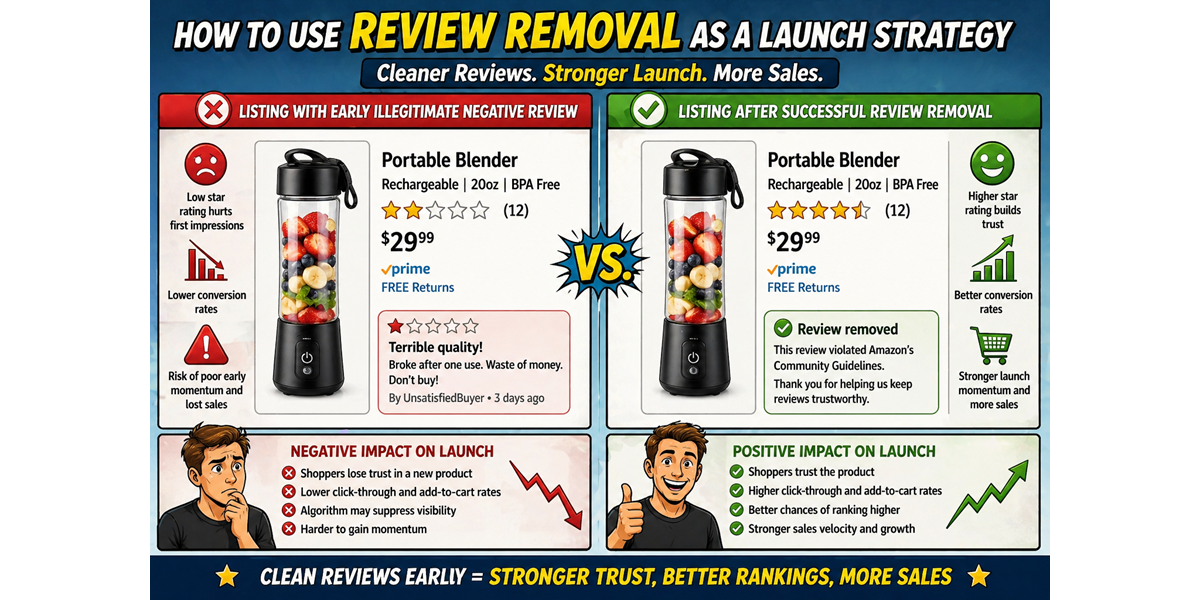
    • Creates a More Positive Initial Impression: By removing unfair negative feedback, you ensure that the first potential customers see are either no reviews (a neutral starting point) or, ideally, genuine positive reviews you start to acquire.
    • Boosts Conversion Rates: A clean or predominantly positive review section early on builds trust and encourages those initial purchases, which are crucial for gaining traction in the algorithm.
    • Increases Organic Visibility: Higher conversion rates signal to Amazon that your product is resonating with customers, which can lead to improved organic ranking over time.
    • Protects Your Brand Reputation: Early negative feedback, even if illegitimate, can tarnish your brand image before you’ve had a chance to establish it. Removing it safeguards your initial reputation.
    • Improves Advertising Effectiveness: When you start driving traffic to your listing through advertising, a clean review section increases the likelihood of those clicks converting into sales, improving your ACoS.
    • Builds Confidence for Future Review Generation: A positive initial reception can encourage genuine customers to leave positive reviews, creating a virtuous cycle.

    Implementing Review Removal as a Launch Strategy (The Right Way)

    1. Thoroughly Monitor New Reviews: As soon as your product launches, diligently monitor all incoming reviews. Set up alerts to be notified immediately of any new feedback.
    2. Understand Amazon’s Review Policies Inside and Out: Familiarize yourself with the latest version of Amazon’s Community Guidelines and Customer Product Reviews Policies. This is crucial for identifying legitimate violations.
    3. Objectively Assess Each Negative Review: Don’t automatically assume every negative review is illegitimate. Carefully analyze the content to see if it genuinely violates Amazon’s policies.
    4. Report Policy Violations Through Seller Central: If you identify a review that clearly violates Amazon’s policies, report it through the designated channels in Seller Central. Provide clear and concise evidence of the violation, referencing the specific policy if possible.
    5. Be Patient and Persistent (Within Reason): Amazon’s review removal process can take time, and they don’t always grant removal requests. Be prepared to follow up politely if necessary, but avoid bombarding them with repetitive requests.
    6. Focus on Generating Positive Reviews Compliantly: While removing illegitimate negatives is a valuable initial tactic, it’s not a substitute for a long-term strategy of ethically generating positive reviews from satisfied customers.

    Important Considerations

    • Don’t Abuse the System: Only report reviews that genuinely violate Amazon’s policies. Falsely reporting legitimate negative feedback can have serious consequences for your account.
    • Focus on Product and Service Improvement: While removing unfair reviews helps with initial perception, the best long-term strategy is to offer a high-quality product and excellent customer service to minimize negative feedback in the first place.
    • Review Removal is Not a Replacement for Review Generation: It’s a complementary tactic to help you get off to a stronger start. You still need a robust strategy for acquiring positive reviews over time.

    Launching with Confidence

    By strategically leveraging the legitimate removal of policy-violating negative reviews during your initial launch phase, you can create a more positive first impression, boost early conversion rates, and build a stronger foundation for long-term success on Amazon. It’s about ensuring that your product gets a fair chance to shine without being unfairly hampered by illegitimate negative feedback right out of the gate.

    Do This

    Launching a new product on Amazon? Let eCom Triage help you start strong. Our expertise in Amazon’s review policies can help you identify and address unfair negative feedback that could hinder your initial momentum.Contact us here for a consultation on your launch strategy.

  • How One 1-Star Review Can Tank Your Sales

    How One 1-Star Review Can Tank Your Sales

    How One 1-Star Review Can Tank Your Sales 

    That dreaded notification pops up – a new 1-star review. Your stomach drops. It’s just one review, right? Can it really do that much damage? The short answer, unfortunately, is a resounding Yes. In the hyper-competitive world of Amazon, even a single negative review can have a disproportionately large impact on your sales and overall business health.

    Let’s dive into why and, more importantly, what you can do about it.

    First Impressions

    Think of your Amazon listing as a digital storefront. Shoppers can’t physically interact with your product, so they rely heavily on social proof – and reviews are the cornerstone of that proof. A stream of positive feedback builds trust and encourages conversions. Conversely, a glaring 1-star review acts like a red flag, deterring potential customers and sowing seeds of doubt.

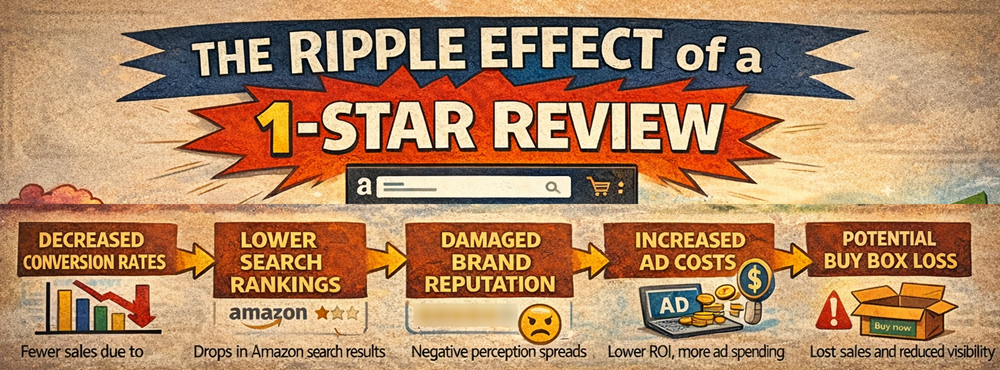
    The Domino Effect of a Negative Review:

    • Reduced Conversion Rates: Potential buyers are naturally risk-averse. Seeing a negative review, especially if it highlights a significant flaw or poor experience, will make them think twice before clicking “Add to Cart.” They’ll likely browse competitor listings with more positive feedback. Even if your overall star rating remains relatively high, that single negative comment can stick in a buyer’s mind.
    • Lowered Visibility in Search Results: Amazon’s algorithm prioritizes listings with strong sales velocity and positive customer feedback. A dip in your conversion rate due to a negative review can signal to Amazon that your product is no longer as appealing, leading to lower organic rankings. This creates a vicious cycle: fewer eyes on your listing mean fewer potential sales, further impacting your ranking.
    • Damage to Brand Reputation: For sellers building a brand beyond just a single product, negative reviews can tarnish your overall reputation. Customers may associate that poor experience with your entire product line, making them hesitant to purchase other items you offer. This is particularly true if the review highlights issues with customer service or product quality consistency.
    • Increased Advertising Costs: To compensate for lower organic traffic and conversion rates, you might feel pressured to increase your advertising spend. However, driving more traffic to a listing with a prominent negative review can be like pouring water into a leaky bucket. You’re paying for clicks from customers who are immediately turned off by the negative feedback.
    • Impact on Buy Box Share: While numerous factors influence Buy Box eligibility, customer satisfaction is a significant one. A sudden influx of negative reviews can negatively impact your seller metrics, potentially leading to a loss of Buy Box share, further hindering sales.

    Why a One-Star Review Carries So Much Weight:

    • The Power of Recency: Amazon often highlights the most recent reviews. A new 1-star review will likely be one of the first things potential buyers see, making its impact even more significant.
    • The Outlier Effect: If the vast majority of your reviews are positive, a single negative one can stand out starkly, drawing more attention to the perceived flaw.
    • Emotional Impact: Negative experiences tend to be more emotionally charged and memorable for customers. They are also often more vocal about their dissatisfaction.

    What Can You Do?

    While you can’t magically erase negative feedback, you can take proactive steps to mitigate its impact and prevent future occurrences:

    • Monitor Your Reviews Diligently: Don’t wait for sales to plummet to check your reviews. Set up alerts or regularly check your listings to identify negative feedback as soon as it appears.
    • Respond Professionally and Promptly: A thoughtful and professional response to a negative review shows potential customers that you care about their experience. Acknowledge their concerns, apologize for any shortcomings, and offer a solution if appropriate (e.g., a refund, replacement, or explanation). This can sometimes even lead to the reviewer updating or removing their feedback.
    • Analyze the Feedback: Don’t just dismiss a 1-star review. Carefully analyze the content. Is it a legitimate product defect, a misunderstanding of the product features, or an issue with shipping (which you might be able to address with Amazon)? Identifying the root cause is crucial for preventing similar issues in the future.
    • Improve Your Product and Processes: Use negative feedback as valuable data. If multiple reviewers mention the same problem, it’s a clear indication that you need to improve your product, packaging, instructions, or customer service processes.
    • Proactively Solicit Positive Reviews (Compliantly): While you can’t incentivize positive reviews, you can implement strategies to encourage satisfied customers to leave feedback. This could include follow-up emails (within Amazon’s guidelines) or using Amazon’s Request a Review button. A higher volume of positive reviews can help to dilute the impact of a single negative one over time.
    • Consider Review Removal (When Appropriate): If a review violates Amazon’s Community Guidelines (e.g., contains abusive language, personal information, or clearly isn’t about the product), you can report it to Amazon for removal.

    Are you proactively monitoring your Amazon reviews and have a strategy in place to address negative feedback? Don’t let a single 1-star review derail your hard work.

    If you’re looking for expert guidance on building a robust review strategy and protecting your listing’s reputation, schedule a call today:

    Schedule A Call With An Expert

  • How Amazon Calculates Star Ratings (and why it’s broken)

    How Amazon Calculates Star Ratings (and why it’s broken)

    Your star-rating impacts visibility, conversion rates, and sales. What you might not know is that Amazon’s method for calculating star ratings is far from perfect. Here’s a breakdown of how it works, and why it’s broken.

    How Amazon Calculates Star Ratings

    Amazon uses an algorithm to calculate your product’s average star rating. You’d think it’s the sum of all ratings divided by the total number of reviews, right? Not quite.

    Here’s how it works.

    • Weighting of Reviews: Amazon’s algorithm doesn’t treat all reviews equally. Recent reviews carry more weight than older ones. So keep doing everything you can to drive positive reviews.
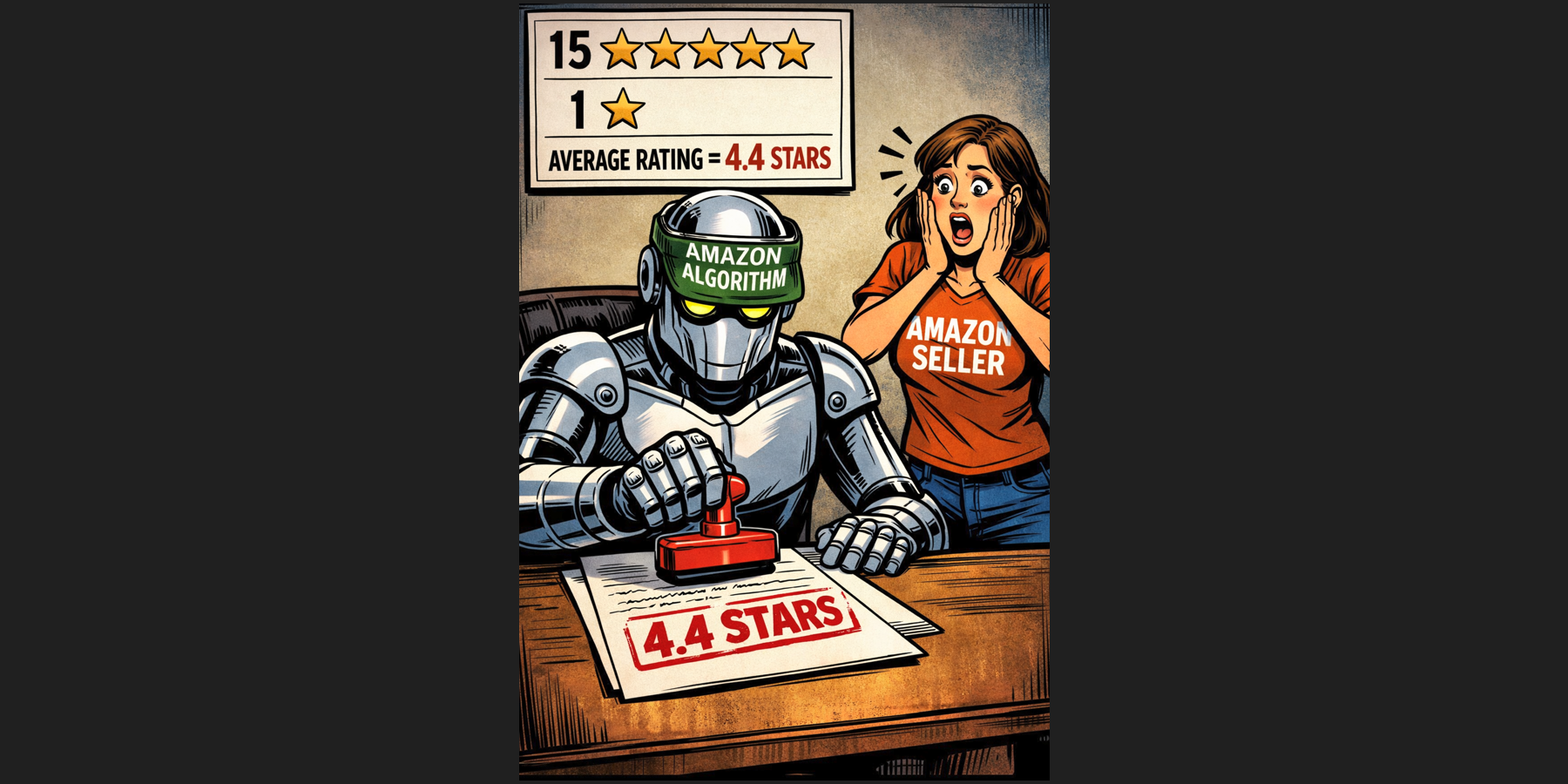
    • Impact of Star Ratings vs. Written Reviews: A 1-star review without a written explanation can outweigh a 5-star review with a detailed written review, especially at lower review quantities. This lack of distinction means that a negative star-rating may not actually reflect genuine issues with the product.
    • Quality of Review Content: Reviews that are detailed, well-written, and deemed helpful by other users can carry more weight. Do everything you can with the customer experience to drive high-quality positive reviews

    Why It’s Broken

    The biggest problem with Amazon’s star rating system is that it oversimplifies reality. A drop from 4.3 to 4.2 stars can be devastating for a product’s sales, yet this might happen due to one poorly timed 1-star review, which could be completely unrelated to the product’s quality.

    Another issue is how certain factors, like shipping or packaging complaints, can affect the star rating despite not being related to the product itself. This puts sellers in a tough spot, as they may end up dealing with unfair reviews they can’t do much about. Amazon rarely if EVER removes reviews that violate their ToS concerning shipping and packaging issues.

    The Takeaway

    While Amazon’s star ratings are a crucial metric, they’re far from perfect. As sellers, it’s essential to focus not just on getting positive reviews, but on strategically managing your review health.

    At eCom Triage we’ve built a free GPT to check your reviews. Schedule a Discovery call to see how we can help with your product reputation management.

    Contact Us Today

  • Stop Being Ignored By Amazon Support: Grab This FREE Guide

    Stop Being Ignored By Amazon Support: Grab This FREE Guide

    Let’s be real – we’ve all been there. Critical listing issues suddenly appear, inventory gets stuck in limbo, or your account faces mysterious restrictions. And what does Seller Support offer? 

    Another useless copy-paste response that has nothing to do with your actual problem, while your sales and metrics continue to suffer.

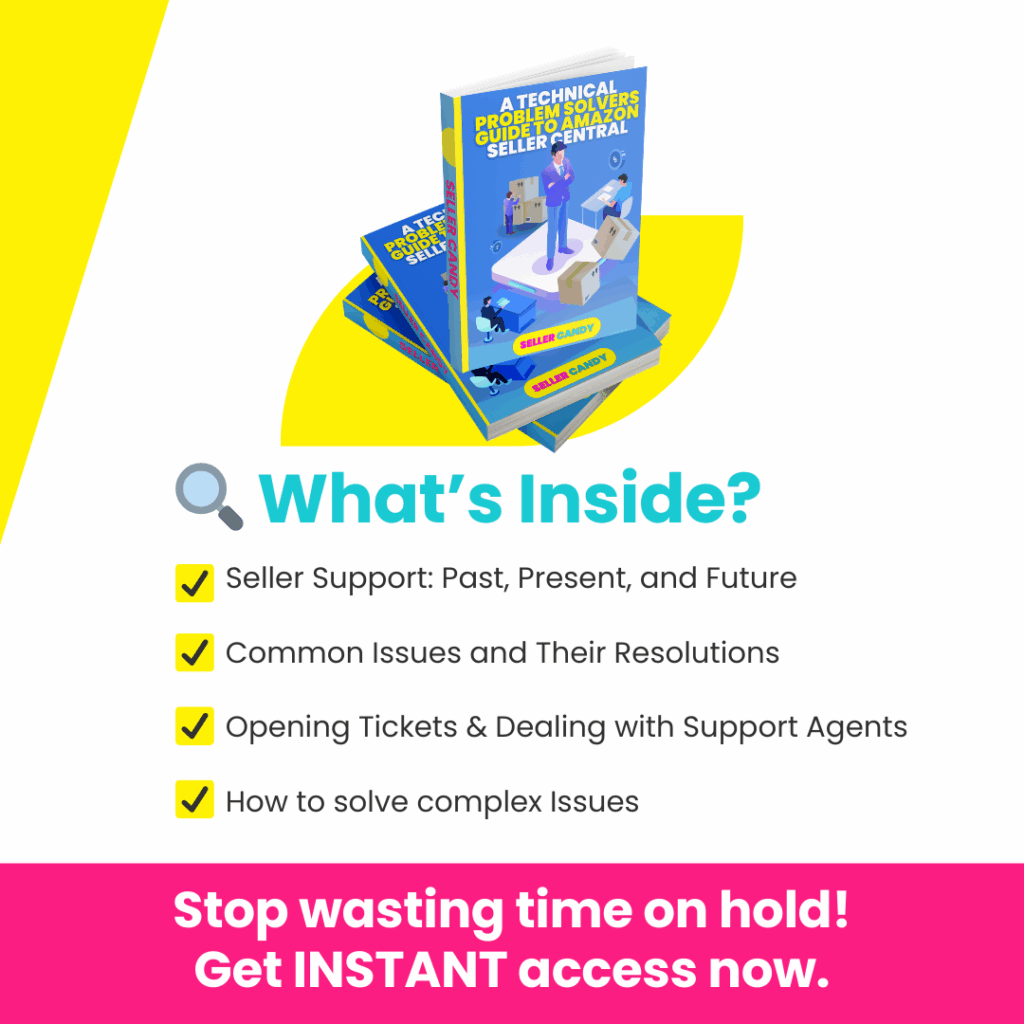
    This week, we’re sharing a game-changer from our friends at Seller Candy. After handling 10,000+ support cases over 5 years, they’ve created the Technical Problem Solver’s Guide to Amazon Seller Central with solutions that actually work.

    Inside you’ll find:

    ➨ Case structures that get routed to the right team immediately

    ➨ Strategic escalation protocols that get results

    ➨ “Magic phrases” that get urgent issues addressed

    Don’t waste hours fighting the system. Keep this FREE guide handy as your emergency toolkit for when Amazon throws a curveball your way.

    A Technical Problem Solvers Guide to Amazon Seller Central 1 3 1
  • Understanding the Amazon Review Algorithm

    Understanding the Amazon Review Algorithm

    This is a collection of my thoughts on the factors that influence Amazon’s rating system.

    It’s a frank discussion, coming from my years of experience. Some of it is based on data provided by Amazon, some of it is an educated guess based on observation, some is pure conjecture. I have a lot more data on this, but for brevity I have stayed out of the weeds on some of the explanations. Despite what I’ve written here, I believe it likely that there are more factors that I have not gone over in this… If you have ideas on what those could be, I’d love to hear them!

    Here are some of the factors that we KNOW impact the rating of your product:

    Recent Reviews

    Amazon specifically states that they assign more significance to the most recent reviews. This is due to the assumption that recent reviews reflect the most current state of the product. Therefore, if you get slammed with a bunch of negative reviews, I believe that it can drop your rating much faster than it should mathematically equate to.

    If your most recent reviews have lower ratings, I think Amazon sees this as a product rapidly trending DOWN or that there is some sort of issue with it.

    I’ve seen many instances of a product having had a 4.3 rating for not just months, but YEARS, then suddenly be strategically hit with a blast of negative ratings and reviews, causing it to drop from a 4.3 to a 4.2 average star rating.

    Time Decay

    If newer reviews hold more weight than older reviews, then you could postulate that reviews gradually contribute less and less weight to the overall rating as time marches on. This would ensure that the star rating reflects the product’s current performance.

    With that said, I also think that if you have a long history of having a high ratings Amazon takes that into account as well.

    Verified Purchases

    Reviews from verified purchasers are considered more trustworthy. That doesn’t mean an unverified review has no impact, just that Amazon claims it does not hold as much weight.

    That being said, I’ve seen evidence to the contrary.

    What I think, therefore, is that the lower the number of reviews, the higher the impact of an unverified review because there’s not as much content to overcome its value.

    Reviewer Credibility and Quality Scores

    A few comments on this follow.

    Quality of Review Content

    Reviews that are detailed, well-written, and deemed helpful by other users can carry more weight. In the case of Google, they’ve gamified the review system.

    • If you’ve got at least 200 characters in the review, it’s considered a well written review.
    • If you add photos, you get more points.
    • If you add LOTS of photos, have a really long review with great detail, and you add video, you can seriously rack up some points.

    I actually think that gamifying the review system would be in the best interest of Amazon, the seller AND the buyer.

    Keywords

    Keywords play a factor in reviews. This is how Dufus is aggregating the data and giving a synopsis of what people do and don’t like. This is of course a two way street when it comes to positive and negative reviews. Unfortunately, this is where fraud really comes into play… In suspicious and fraudulent reviews, I VERY often see alarming statements, usually in all capital letters: 

    • DO NOT BUY
    • BUYER BEWARE
    • DANGEROUS
    • HORRIBLE
    • BROKEN
    • Et cetera

    This means that if a competitor wanted to smack you down in the ranking, they can have a bunch of buyer accounts buy your product and leave a bunch of reviews stuffed with specific keywords to alarm Amazon’s algorithm.

    Reviewer Social Score

    I believe that buyer accounts who consistently provide write reviews may have their ratings and reviews weighted more significantly than others who only leave star ratings or occasionally write reviews.

    I have nothing to substantiate this, I am making an educated guess based on the fact that they consider the most recent reviews to have more weight. So if you have an account that leaves reviews with lots of well written content, those reviews will hold more weight.

    This means that if a buyer account has a bunch of well written low-star reviews, it can lower the average rating more quickly than a buyer account that has only ever left 3 reviews.

    Suspicious or Fraudulent Activity

    You would think that Amazon’s algorithm would “downweight” or exclude reviews that were suspected of being fake or biased. But I have seen so many instances of accounts where all evidence points to them being fraudulent accounts, yet no action is taken against those reviews or the buyer account. Some of the things that YOU should be looking for are:

    • The buyer account
      • What do the reviews look like from that account? Are they primarily good or bad? Are they ALL good or bad?
      • How often does the account leave reviews
      • Has the buyer account left critical reviews on all of your competitors except one? \
    • Your account
      • Have you had a sudden blast of negative reviews? Did your rating just drop and suddenly the negative reviews coming just stopped?
      • Do you see similarities between the reviews that have been coming in? Same image in the review? Same claims? Same EXACT text?

    In Closing

    I believe this is a topic high on the minds of Amazon sellers in particular, and now eCommerce entrepreneurs in general since the FTC has officially made it illegal to acquire or promote fake reviews and testimonials.

    As a long-time Amazon seller and entrepreneur myself, with years of additional experience as an owner and executive at several third-party companies dedicated to providing services and software to help Amazon sellers succeed, I felt it was time to share my thoughts in a format like this.

    Amazon keeps a lot of secrets. This we know. But there are many of us, and we observe things, we learn things, and as we learn I believe it’s important we share, discuss, and learn even more.

    Hit me up with your own observations or any questions.

  • 3 star rating – Amazon’s Review Algorithm

    3 star rating – Amazon’s Review Algorithm