

News from the Seller Community
Policy & Tactics
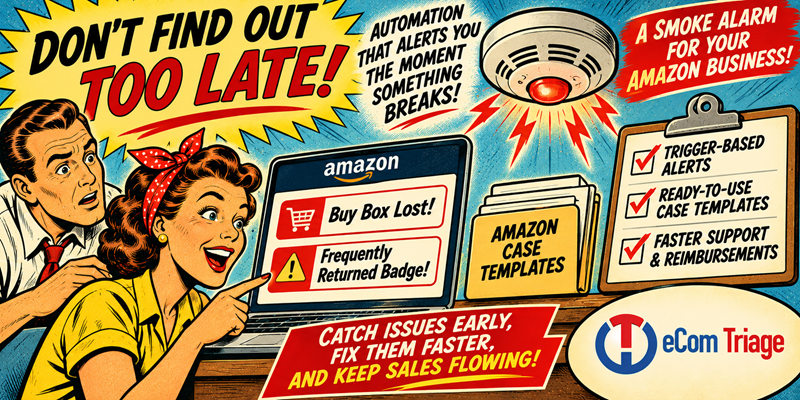
Alerts Beat Sweeps
You lost the Buy Box on Tuesday and found out on Friday, when the sales report looked strange.
Not an uncommon occurrence.
One seller I spoke with this week asked the right question:
Can automation fire a trigger the moment something breaks? Such as when you lose the Buy Box or get a “frequently returned” badge, instead of waiting for a scheduled sweep?
The answer is yes, and it’s a good idea.
Weekly checks are fine, but for certain things you need an alarm. The same seller named another time sink:
Filing Amazon cases and chasing reimbursements.
Solution? A set of copy-paste templates can get you through the hurdles in Amazon’s support flow. Trigger-based alerts plus ready-made case templates are worth building before the next Q4 fire.
Compliment your weekly sweeps with trigger-based alerts for your most important thresholds.
Reviews & Ranking
Protect the Listings Next Door Before the Launch
One brand this week was trying to stop a slide in their rating, because their rating was one dip away from the next tier down. They also wanted two sibling listings covered, and new color variations were about to land.
The best policy is to handle negative reviews in related listings before launching a new one. It’s like laying sandbags before the storm instead of mopping afterward.
Ranking damage is far cheaper to prevent than to reverse. Check which of your neighboring ASINs are carrying a cluster of negative reviews before you add anything new to the family.
See how I can help.
From the eCom Growth Show Podcast

Episode #93
AI Workflows to Scale Your Ecommerce Brand with Andrew Erickson
In this episode of The eCom Growth Show, Danan Coleman welcomes back Andrew Erickson, founder of Inventory Hero, to explore practical AI workflows that help ecommerce brands operate smarter, save time, and unlock new growth opportunities.
From Amazon listing optimization and PPC management to inventory forecasting, email automation, and multichannel expansion, Andrew shares how sellers can use artificial intelligence to streamline operations without losing the human expertise that drives business success.
Click the Play button above to watch.
For our full selection of episodes click here 👇
Upcoming eCom Events
Affiliate World Asia 2026 (Dec 9 & 10)
A two-day performance-marketing conference for affiliate marketers, media buyers, advertisers, networks, ecommerce brands, agencies, and technology providers.
NRF 2027: Retail’s Big Show (Jan 10-12)
Join more than 41,000 retail professionals in New York City to explore the technology, trends, and strategies shaping the future of commerce.
Prosper Show 2027 (Mar 2-3)
Never too early to start thinking about this one. Prosper brings together marketplace sellers, ecommerce brands, operators, agencies, technology providers, and industry experts for two focused days.
European Seller Conference 2027 (Apr 7-10)
The European Seller Conference 2027 is a premier in-person event for established Amazon sellers generating $1–5 million in annual sales who are ready to scale to the next level.
For a full list of industry events (and great parties to attend) visit Ecom.Events:
[ Ecom.Events ]
Black Hat Watch

PPC Click & Ad-Spend Draining
What will the bad guys think of next? Is there no end to their desperate efforts to cheat and suppress the competition?
Seems they’d do way better if they focused that energy on building their own business, rather than spending so much time trying to crush yours.
What It Is
This is where competitors deploy automated bots or manual click-farms to repeatedly click on a brand’s sponsored Amazon PPC ads, burning through their daily advertising budget early in the day and hiding the product from shoppers.
Spotting and defending against PPC click fraud (click draining) requires a mix of data monitoring, campaign structuring, and leveraging Amazon’s internal detection systems.
Because Amazon does not provide real-time IP logs of who clicks your ads, you have to look for anomalies in your advertising reports.
How To Spot It
- Sudden CTR Spikes with Zero Conversions: Look for campaigns where the Click-Through Rate (CTR) abruptly jumps (e.g., from a normal 0.5% to 5% or higher) on specific keywords, but the conversion rate drops to absolute zero.
- Rapid Budget Depletion: Your daily budget routinely lasts until 8:00 PM, but suddenly drains completely by 6:00 AM or 7:00 AM without a corresponding surge in sales.
- Identical Search Term Patterns: Review your Search Term Report. Look for a sudden, massive influx of clicks coming from a hyper-specific, unusual long-tail search term that has never performed well before.
- Hourly Spend Anomalies: Check your Amazon Marketing Stream (hourly data) or third-party PPC software. A massive spike of 50 clicks in a single 15-minute window during off-peak hours (like 3:00 AM) is a strong indicator of a bot script.
How to Defend Against It
Amazon does have built-in automated filters to detect and invalidate “invalid clicks” (and they will programmatically refund your account for them), but bots can sometimes bypass these filters.
Here is how you can actively defend your budget:
- Shift to Exact Match Keywords: Competitors often use broad or phrase match to trigger click bots across a wider net of your terms. Moving your high-budget, high-risk keywords to Exact Match limits the surface area they can target.
- Utilize Dayparting (Hourly Scheduling): Use Amazon Marketing Stream or a third-party PPC tool to implement dayparting. Turn off or heavily reduce your ad bids during late-night or early-morning hours (e.g., 12:00 AM to 5:00 AM) when bot farms frequently run their scripts to drain budgets before real shoppers wake up.
- Set Campaign Budget Caps and Portfolio Limits: Do not rely on a single campaign with a massive budget. Distribute your keywords across multiple campaigns and place them into an Amazon Advertising Portfolio with a strict overarching budget cap to contain the financial damage if one campaign gets hit.
- Lower Bids on Sabotaged Keywords: If you identify a specific keyword being targeted, temporarily lower the bid significantly. This forces the competitor’s bot to click on cheaper ads, or drops your ad placement to the bottom of the page where the bot may not find it, breaking their script.
- File an Invalid Click Investigation Case: If you gather data showing a clear attack, open a case with Amazon Advertising Support. Present your data (Campaign ID, affected keywords, specific dates/times, and the sudden CTR variance) and request a manual audit for an Invalid Clicks Refund.
I Can Help
I also offer consulting, and can help set up systems to protect your listing from black hats and other issues that shouldn’t be setting you back or slowing you down.
This Week’s Dad Joke 😁
A priest, a rabbi, a nun, two gorillas, a clown, a leopard, a horse, three turtles, a mime, a ninja and a dragonfly walk into a bar.
Bartender yells, “What is this, some kind of joke?”